
Publications
These articles and publications aim to offer insights into both the ideas behind our work, drawn from academic research, and our practical approach to helping school leaders put those ideas into action over an extended period. Click the image to read the article.
Using social psychology to create inclusive education
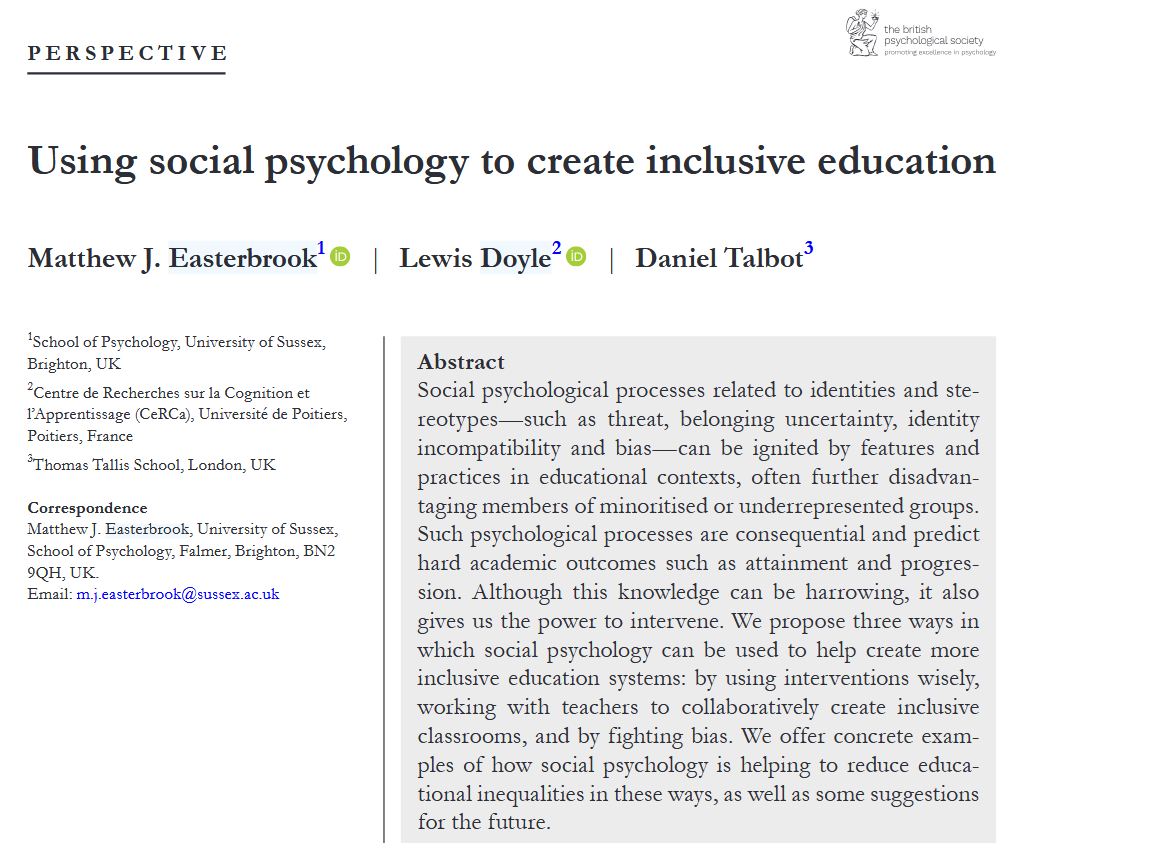
This article by Matt, Lewis Doyle, and Daniel, published in The British Journal of Social Psychology, gives an overview of relevant academic research that our approach draws on, as well providing recommendations for teachers and educationalists regarding how to create inclusive education. (It is freely available)
Context matters: Diagnosing and targeting local barriers to success at school
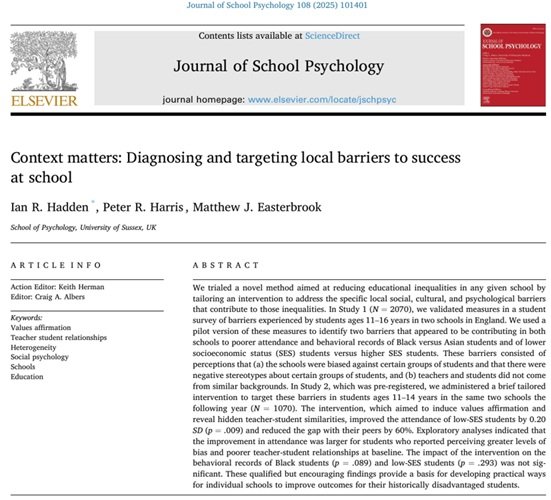
This study by Ian and Matt in the Journal of School Psychology is effectively a trial of our whole approach. Across two schools, we diagnosed the specific barriers holding particular groups back, then delivered a brief intervention tailored to each school. The results were striking: lower-income students' attendance rose by four days a year, closing the gap with peers by 60%, and the average time Black students spent in detention fell from 176 to 90 minutes — narrowing that gap by around 83%.
Tackling educational inequalities with social psychology: Identities, contexts, and interventions

This academic paper describes in detail the theoretical underpinnings of our work and the vast amount of research that it draws on. It is meant to be a comprehensive review and so it isn’t short, but it may be of interest to those of you who want to delve more deeply into the academic side of what we do.
Copyright © 2024. The School Inclusion Group, University of Sussex. All rights reserved.
Additional relevant articles:
- 'People like me don't do well at school' — pupils on free school meals are less likely to agree that "people like me do well at school", which partly explains the attainment gap — but schools can close it by building inclusive environments. Easterbrook et al. (2022). — https://doi.org/10.1111/bjep.12494
- Self-affirmation reduces the socioeconomic attainment gap — a randomised controlled trial where a brief affirmation exercise closed the attainment gap for low-income pupils by around 62%. Hadden et al. (2020). — https://doi.org/10.1111/bjep.12291
- Long-term effects of values affirmation — a follow-up of the 2020 trial showing some benefits lasted to GCSE Attainment 8, two to four years later. Hadden, Harris & Easterbrook (2024). — https://doi.org/10.1111/bjep.12711
- A large-scale independent evaluation — found values affirmation benefits the attainment of free-school-meal pupils (Matt led the trial; See and colleagues were the independent evaluators). See et al. (2022). — https://doi.org/10.1080/13803611.2021.2022317
- Teacher expectations of low-income students, and when it strikes — teachers, like all of us, are prone to unconscious bias, especially against lower-income pupils; it is hard to recognise in ourselves and most likely to surface when we are busy or under cognitive load. Doyle, Easterbrook & Harris (2022); Doyle, Harris & Easterbrook (2024); Doyle, Easterbrook & Harris (2024). — https://doi.org/10.1111/bjep.12541 · https://doi.org/10.1007/s11218-023-09882-z · https://doi.org/10.1007/s11218-023-09832-9
- Helping teachers build confidence with inclusive practices — specific things that can help teachers recognise and counter bias, which we explore in our workshops. Doyle & Easterbrook (2024); Doyle, Tropp & Easterbrook (2025). — https://doi.org/10.1111/josi.12648 · https://doi.org/10.3102/0013189X251322791
- An empathy intervention reduces the gender gap in discipline — a brief intervention aimed at helping teacher approach discipline with respect and connection raised students’ belonging and cut disciplinary sanctions, especially for boys. Doyle, Harris & Easterbrook (2025). — https://doi.org/10.1002/ejsp.3146
- Self-affirmation theory in educational contexts — reviews why brief affirmation exercises can narrow attainment gaps, and why their effects vary. Easterbrook, Harris & Sherman (2021). — https://doi.org/10.1111/josi.12459
- Wise interventions and youth mental health — a meta-analysis showing wise interventions, and gratitude interventions in particular, can reduce depression and anxiety among young people. Parlak et al. (2025). — https://doi.org/10.1007/s10578-025-01832-4
Copyright © 2024. The School Inclusion Group, University of Sussex. All rights reserved.